


Singing Bowls and Sound Healing: More Than Just Sound
(By Marleen van Erp)
Have you ever noticed how a certain sound can immediately change how you feel? The sound of the ocean can make you feel calm. Music can bring back a memory or change your mood within seconds. A mantra can help to settle the mind, while the sound of a singing bowl can create a feeling of deep relaxation and stillness.
Singing bowls are now widely used in yoga, meditation and wellness practices. But why can sound have such an effect on us? And what happens in the body when we listen to a singing bowl? In this article, we explore the science behind sound and vibration, how they may interact with the body and nervous system, and what current research can and cannot tell us about sound healing.
Sound Healing and Yogic Tradition
Sound has always played an important role in yoga and spiritual traditions. From mantra and Vedic chanting to meditation and prayer, people have used sound to focus the mind and turn attention inward.
Although not an official limb of yoga, sound is deeply connected to the traditional yogic teachings. One of the most familiar examples is Om, which is traditionally used in yoga and meditation as a sacred sound. Mantra repetition and Vedic chanting use sound, rhythm, pronunciation and repetition to help develop concentration and steadiness of the mind. In these practices, the purpose is not simply to listen to a pleasant sound. Sound becomes a tool for meditation. When we repeat a mantra or listen carefully to a continuous sound, the mind has something to focus on. Instead of continuously following scattered thoughts, we begin to develop a more one-pointed awareness.
This is one reason sound fits so naturally within a yoga practice.
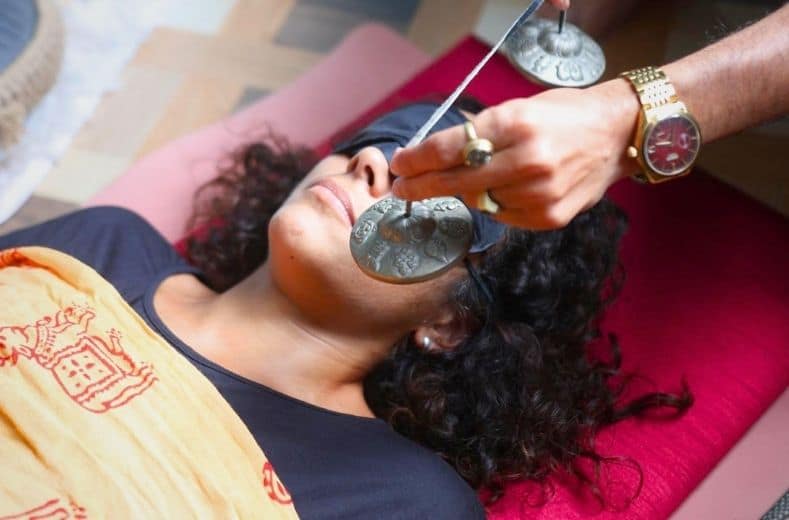
What Is Sound and Sound Healing?
Sound is a form of mechanical energy. When an object vibrates, it creates pressure waves that travel through a medium such as air. We perceive these waves as sound, but sound can also interact with the body as a form of mechanical stimulation.
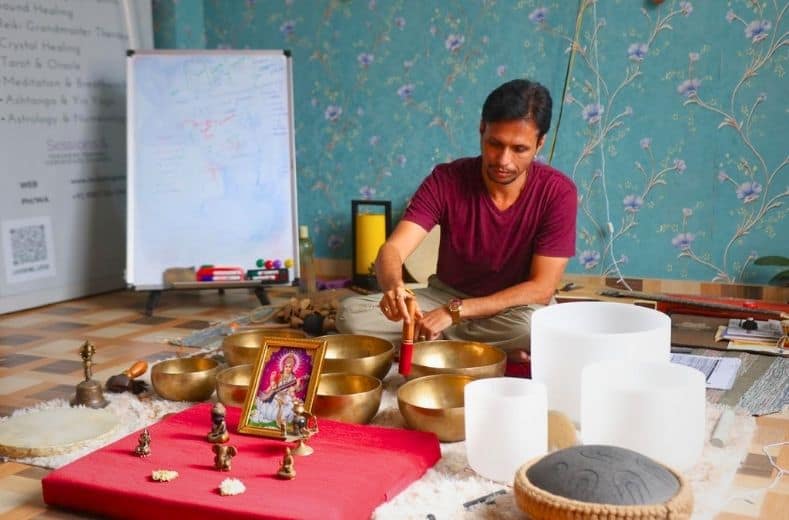
Singing bowls create sound through vibration. They produce complex sounds containing several tones and frequencies. When you strike a bowl or play around its rim, it begins to vibrate and produces tones that can continue for some time. Unlike a short musical note, the sound of a singing bowl slowly unfolds. You hear the initial tone, but you can also hear the layers within it as the sound gradually fades into stillness.
Sound healing explores the intentional use of sound and vibration to influence how we feel, both physically and mentally. You don’t just hear this sound. Depending on the instrument and how close you are to it, you may also notice the vibration physically.
Can Sound and Vibration Affect the Body?
Once we understand that the body can respond to mechanical forces, an important question arises: can sound and vibration influence what happens inside the body?
Our bodies are constantly exposed to vibrations, both from the sounds around us and from movement within the body itself. Cells and tissues can respond to physical forces and pressure changes. Scientists study this process under the term mechanotransduction, the way cells sense and respond to mechanical signals.
This helps explain why sound and vibration interest researchers. Studies are exploring how sound-based practices may interact with the human body, nervous system and even cells.
Research into mechanotransduction has shown that mechanical forces can influence cellular signalling, gene expression and other biological processes. Scientists are also studying how different forms of vibration and acoustic stimulation may influence cellular behaviour and potentially support regenerative processes.
But what does this mean for singing bowls? It doesn’t mean that we can say a particular singing bowl frequency will heal a particular disease or regenerate damaged tissue. That would go beyond the current evidence. We can say that cells can respond to mechanical and vibrational stimuli, and research into acoustic and vibration-based therapies continues to explore how to use this knowledge therapeutically.
The body’s response to sound, however, is not only about cells. Sound can also influence attention, emotions and the nervous system, which may help explain why sound-based practices can feel so deeply relaxing.
Sound, Relaxation and the Nervous System
You do not need to understand the science to experience the effect of sound. Listening to sound can create space for the mind to focus on fewer things. Instead of responding to external demands, attention can settle on the sound itself, supporting calm and relaxation.
This simple practice can help develop dharana concentration by giving the mind a clear object of attention. With regular practice, sound can therefore become more than something relaxing. It can become another doorway into meditation and inner awareness.
The nervous system plays an important role in how the body responds to stress and relaxation. Because sound can influence attention, emotions and physiological responses, researchers are interested in how sound-based practices may interact with the nervous system.
Research on singing bowls has reported changes in measures such as heart rate, blood pressure, respiratory rate, and brain activity, alongside improvements in anxiety, tension, and mood.
Key Points of the Ancient Wisdom and Modern Science
Yoga has used sound, vibration, and mantra for centuries. Modern science is now investigating how sound and vibration may affect the body and nervous system.
This growing field of research gives us a fascinating opportunity to look at something traditional practices have understood for a long time: sound is not only something we hear; it is something we experience with the whole body.
We are still learning exactly how these mechanisms work. Perhaps this is what makes sound healing so interesting: it combines an ancient understanding with a modern scientific field that is still developing. We do not need to claim that sound can cure everything. We can stay curious about what sound and vibration may be able to do—and experience the practice for ourselves.
Experience Sound Healing at Raj Yoga School
You can book sound healing sessions at Raj Yoga School. Through our sound healing sessions, we offer you the opportunity to slow down, relax, and experience the effects of sound and vibration in a peaceful environment. Whether you are a yoga practitioner, teacher, or simply curious about sound healing, you are welcome to experience a session with us.
For availability and bookings (private and group), please contact us via WhatsApp at +918551913969.
References and further reading
- Cai, Y. et al. (2025). Therapeutic effects of singing bowls: A systematic review of clinical studies. Integrative Medicine Research, 14(2), 101144, PubMed.
- Di, X. et al. (2023). Cellular mechanotransduction in health and diseases: from molecular mechanism to therapeutic targets. Signal Transduction and Targeted Therapy, Nature.
- Johnson-Love, O. et al. (2025). Vibration-based cell engineering. Nature Reviews Bioengineering, 3, 408–429.
- National Centre for Complementary and Integrative Health (NCCIH). Music and Health: What You Need To Know, NCCIH.