


Menstruation and Yoga Practice
(by Marleen van Erp)

Yoga encourages regular practice and consistency, yet the menstrual cycle invites us, as female practitioners, to slow down and listen more closely to the body’s needs. How can we honour both? To explore this question, we turn to traditional yogic texts and teachings, alongside modern perspectives, to understand how practice may naturally adapt during menstruation – supporting continuity while remaining aligned with the body’s natural rhythms.
The menstrual cycle is a natural and essential rhythm of the female body. During menstruation, the body undergoes a natural process of release, often accompanied by changes in energy levels, sensations, and emotions. This phase naturally calls for a more inward orientation and a quieter pace. For many women, this is a time when doing less, rather than more, supports balance and wellbeing.
Within yoga practice, this invites a softer, more attentive approach. Instead of pushing through fatigue or discomfort, menstruation can become a time of deeper listening, allowing the body to move – or rest – at its own pace. Even a basic awareness of the cycle helps you adapt your practice with greater sensitivity and respect for your body’s cyclical rhythm.
A brief note on the cycle
From a physiological perspective, menstruation marks the beginning of the cycle, a phase in which hormone levels are relatively low and the body sheds the uterine lining. During this time, energy may naturally dip, and the nervous system can be more sensitive. Gentle movement, breath awareness, and rest support the body’s need for recovery during this phase.
These natural processes are also reflected in yogic understanding, particularly in relation to apāna vāyu, the downward-moving force responsible for elimination and reproductive functions. Let us explore how this understanding manifests across different yogic lineages and how it can be integrated into our daily practice.
Traditional yogic viewpoints on menstruation and asana practice
A Classical yogic text does not provide detailed, menstruation-specific guidelines for asana practice. However, several respected modern yoga lineages offer clear perspectives grounded in yogic principles, observation, and long-standing practice.
Iyengar Yoga
In Light on Yoga, B.K.S. Iyengar offers practical guidance for practice during menstruation:
“Menstruation: Avoid asanas during the menstrual period. But if the flow is in excess of normal, Upavistha Konasana, Baddha Konasana, Virasana, Janu Sirsasana, Paschimottanasana and Uttanasana may be performed with beneficial effect. On no account stand on your head during the menstrual period.”
— B.K.S. Iyengar, Light on Yoga
Iyengar’s approach adjusts practice to support the body during this phase:
- Inversions are avoided;
- Strong abdominal work is discouraged;
- Supported, gentle seated and forward bending postures are favoured.
Iyengar’s guidance cautions against inversions, particularly headstand (sirsasana), during menstruation, while acknowledging that certain grounded, forward-bending and seated postures may be supportive when practised gently.
In Yoga: A Gem for Women, Geeta Iyengar further explains menstruation in relation to apāna vāyu. Practices such as inversions and strong abdominal contractions are avoided to avoid disturbing the natural downward flow that is active during this time.
Ashtanga Vinyasa Yoga (Sri K. Pattabhi Jois)
In the Ashtanga tradition, menstruation is traditionally observed as a “ladies’ holiday.”
- Full asana practice is paused, especially during the first two to three days.
- Ashtanga’s strong heat-building and bandha-focused approach is considered incompatible with the intense activation of apāna vāyu already present during menstruation.
Rest on heavy days is not seen as avoidance but as respect for the body’s natural rhythm.
Sivananda Yoga & Bihar School of Yoga
These traditions recommend moderation rather than complete cessation.
- Avoid headstand, shoulderstand, intense backbends;
- Avoid stimulating practices such as kapālabhāti and bhastrikā;
- Gentle, mindful practice is considered acceptable.
Shared understanding across traditions
Despite variations in approach, these lineages share several core principles:
- Avoid inversions;
- Avoid intense abdominal or bandha-focused practices;
- Reduce intensity or rest completely on heavy days.
Across traditions, menstruation is understood as a time when practice shifts from effort to support, from outward expression to inward listening.
Modern yogic viewpoints
Contemporary yoga teachings continue to explore how practice can best support women throughout their cycle. Many modern approaches emphasise:
- Adapting intensity during menstruation;
- Prioritising rest, breath, and grounding practices;
- Reducing strain on the abdominal and pelvic area;
- Listening to individual experience rather than following rigid rules.
Research on yoga and menstrual health suggests that mindful yoga practice may help reduce menstrual discomfort, support nervous system regulation, and improve overall well-being when adapted appropriately.
Simple practice suggestions during menstruation
Yoga practice during menstruation is best approached with gentleness and discernment. Especially during the first few days of the cycle, when the body is actively releasing, it can be supportive to pause asana practice altogether. Rather than seeing this as an absence, it may be understood as an appropriate and intentional pause, and a conscious choice.
In these initial days (often the first three to four), practice may consist solely of calming pranayama (without retention), breath awareness, and meditation. This supports deep rest and respects the natural movement of apāna vāyu.
As the flow lessens and energy gradually returns, gentle asana may be reintroduced, always guided by sensitivity and self-observation rather than external expectations.
What to emphasize:
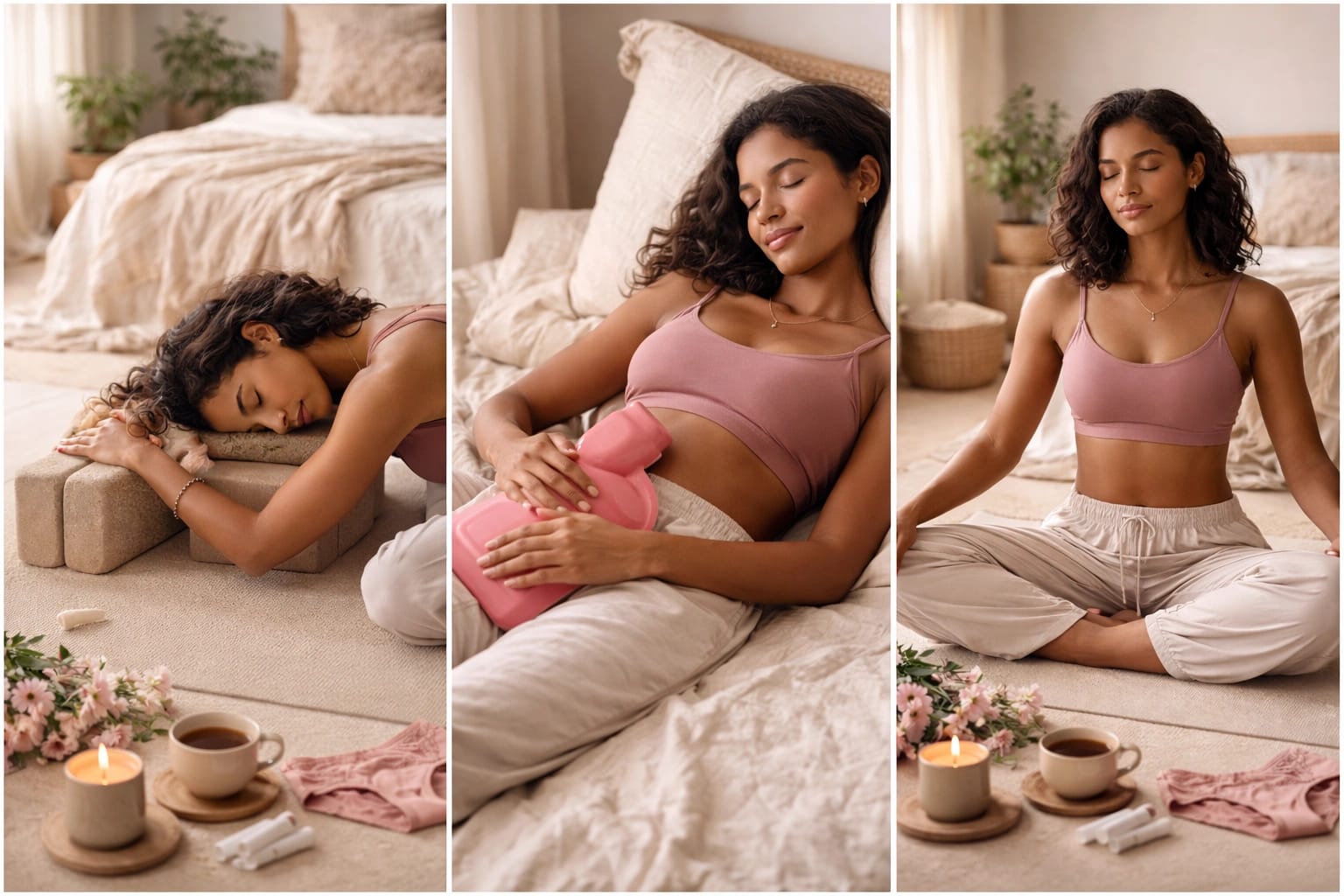
- Restorative and grounding postures, such as gentle seated poses and supported forward bends.
- Slow, conscious breathing, without force or retention.
- Longer pauses and stillness, to settle the nervous system.
- An inward focus, adjusting or stopping when the body asks for rest.
Practices that encourage softness, release, and stability often feel most supportive during this phase.
What to avoid:
- Strong inversions, especially headstand and other poses where the body is fully inverted.
- Intense abdominal work or strong backbends.
- Forcing or pushing through discomfort or fatigue.
- Competitive or performance-oriented practice.
As both tradition and physiology emphasise, practice during menstruation is not about achievement, but about care.
Practising with awareness
Ultimately, practising yoga during menstruation is not about restriction, but about a relationship with the body, breath, and inner state. A cycle-aware approach allows yoga to remain a supportive, sustainable practice over time, honouring the body’s rhythms and needs.
This perspective on practice is part of the broader yogic framework explored at Raj Yoga School through study, practice, and retreat.
We’d love to hear from you. How does your yoga practice shift during your menstrual cycle? Do you make a conscious decision during this time? You’re welcome to share your experience in the comments below.